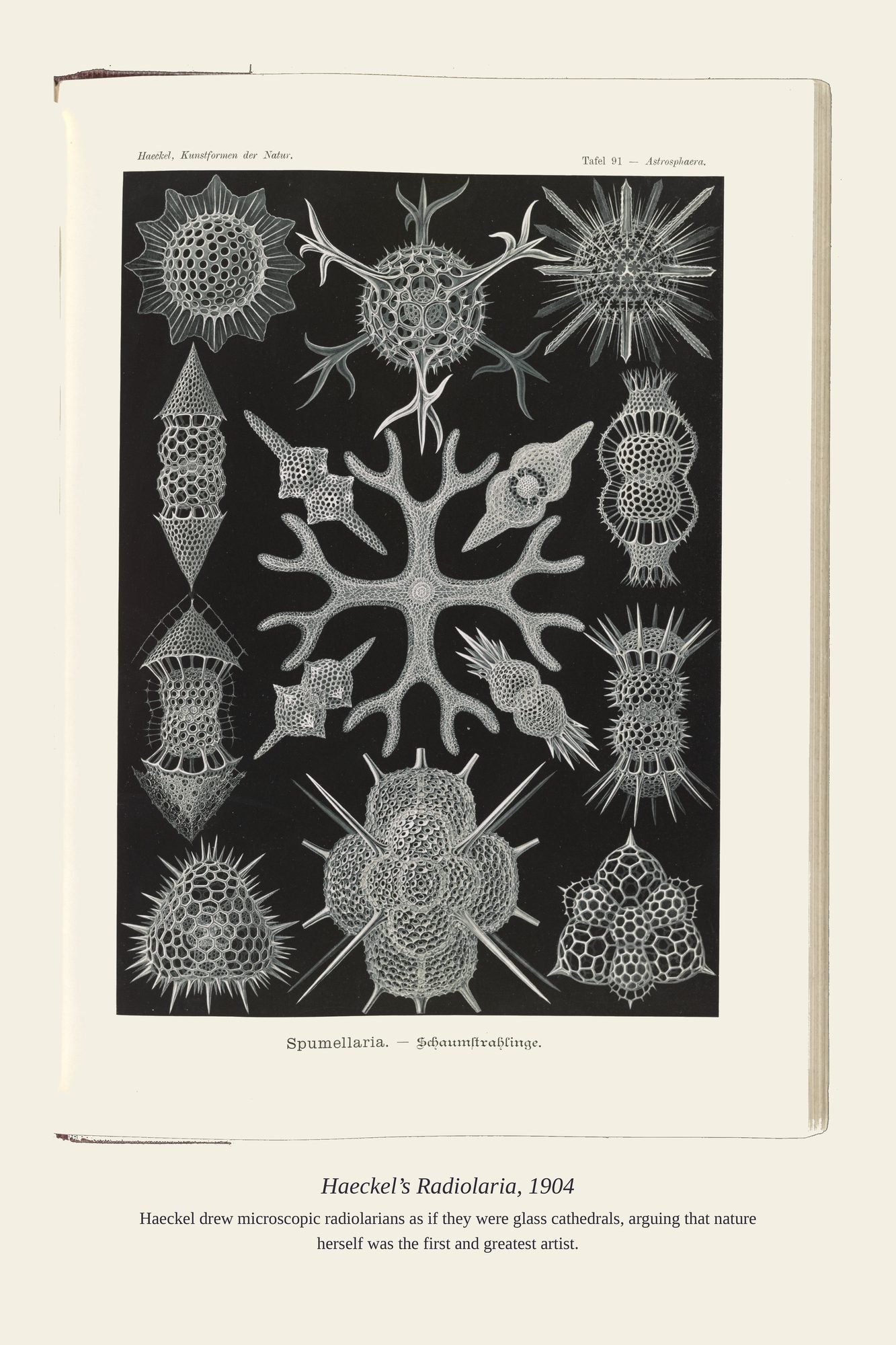
Haeckel’s Radiolaria, 1904 — Antique Historical Print
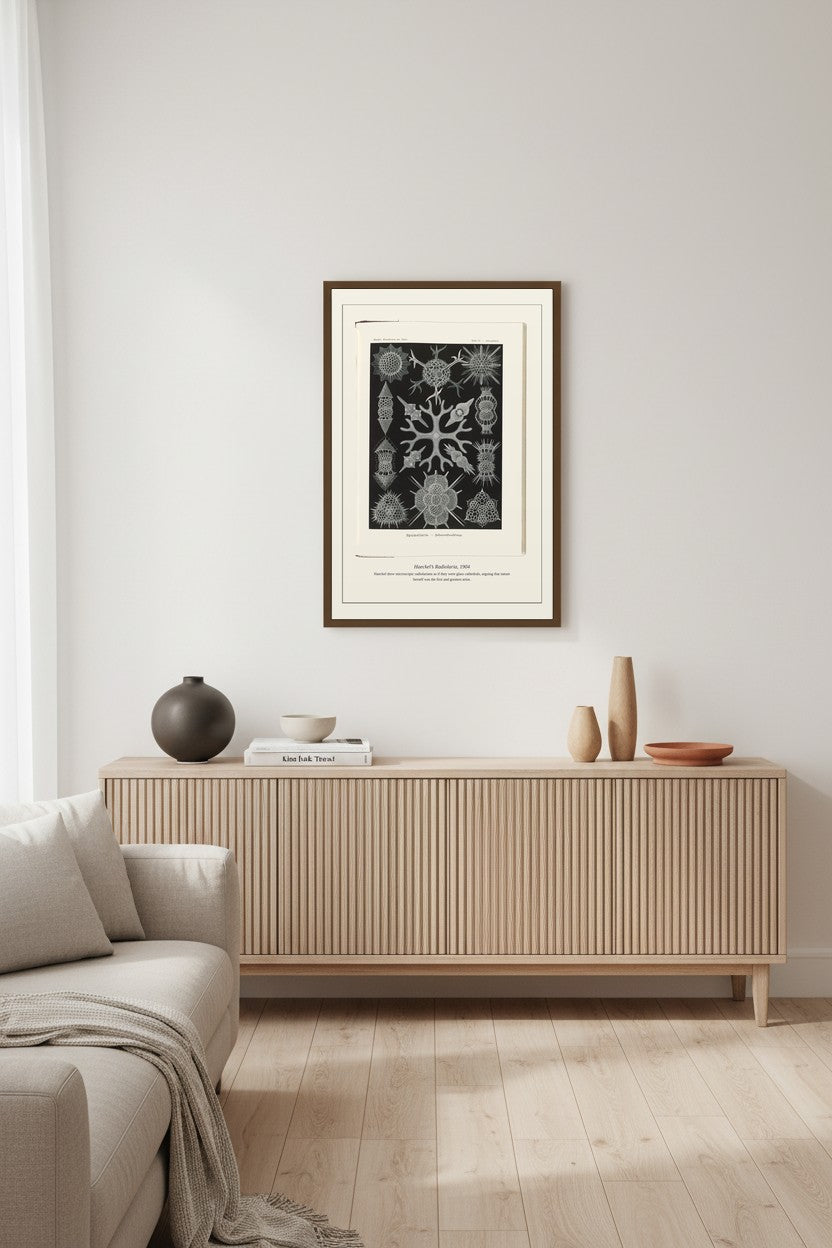
Haeckel’s Radiolaria, 1904 — Antique Historical Print
Couldn't load pickup availability
The Story in the Margin
Radiolaria are single-celled marine plankton that build intricate, glass-like skeletons of silica, often barely a hair's width across yet organised into lattices and spines of near-perfect geometric symmetry. Ernst Haeckel devoted much of his early scientific career to them, describing and naming more than 4,000 species after first studying them under the microscope in the 1860s; their skeletons, sinking by the trillions, still blanket parts of the ocean floor as siliceous ooze. At least one radiolarian plate appears in almost every set of ten prints that make up Haeckel's 1899-1904 atlas, Kunstformen der Natur (Art Forms in Nature) — the very group that first made his scientific reputation.
Materials & origin
- Material: 200 gsm gallery-grade, acid-free fine-art paper (FSC-certified).
- Print: Archival giclée, 12-colour printing, smooth matte finish for glare-free display.
- Artwork: Restored from a public-domain original; colour and detail digitally cleaned for large-format print.
- Origin: Made on demand and shipped from the print hub nearest you, cutting transit and waste.
- Framing: Sold unframed; ships rolled in a protective tube.
Share


As Featured In